

What ARPANSA UV Testing Means for PPF in Australia
Australia runs some of the highest UV levels of any inhabited place on earth. For paint protection film that is not a footnote, it is the main event: UV exposure is what ages a film, and a film that survives a Melbourne or Brisbane summer without changing is a different product from one that merely looks good on day one.
Why UV is what ages a film
Most of the failures a warranty exists for trace back to radiation load. Yellowing happens when the film or its adhesive breaks down under UV. Gloss loss, surface cracking and staining follow the same path. That is why the covered defects on our warranty page read the way they do: yellowing, staining, bubbling, peeling and cracking are all, in large part, UV stories.
Cheaper films manage this badly for a structural reason. Lower-grade polyurethane chemistry yellows as UV attacks the polymer chains, and once the adhesive layer starts to degrade, no amount of surface care brings it back.
The construction that has to pass
Defcon Glanz is built on a premium aliphatic TPU with a UV-protective top coat that shields the adhesive from yellowing. The full stack measures 190±10% microns, about 7.5 mils, including a 13-micron self-healing top coat. Aliphatic TPU is the chemistry chosen specifically because it holds its clarity under sustained UV, where cheaper aromatic formulations shift colour.
Satin films carry an extra burden. Matte and satin finishes show uneven fading and surface discolouration sooner than gloss if the film is not built for it, which is why Defcon Frozen uses the same UV-protective top coat approach over its satin texture.
Tested in Melbourne, not assumed
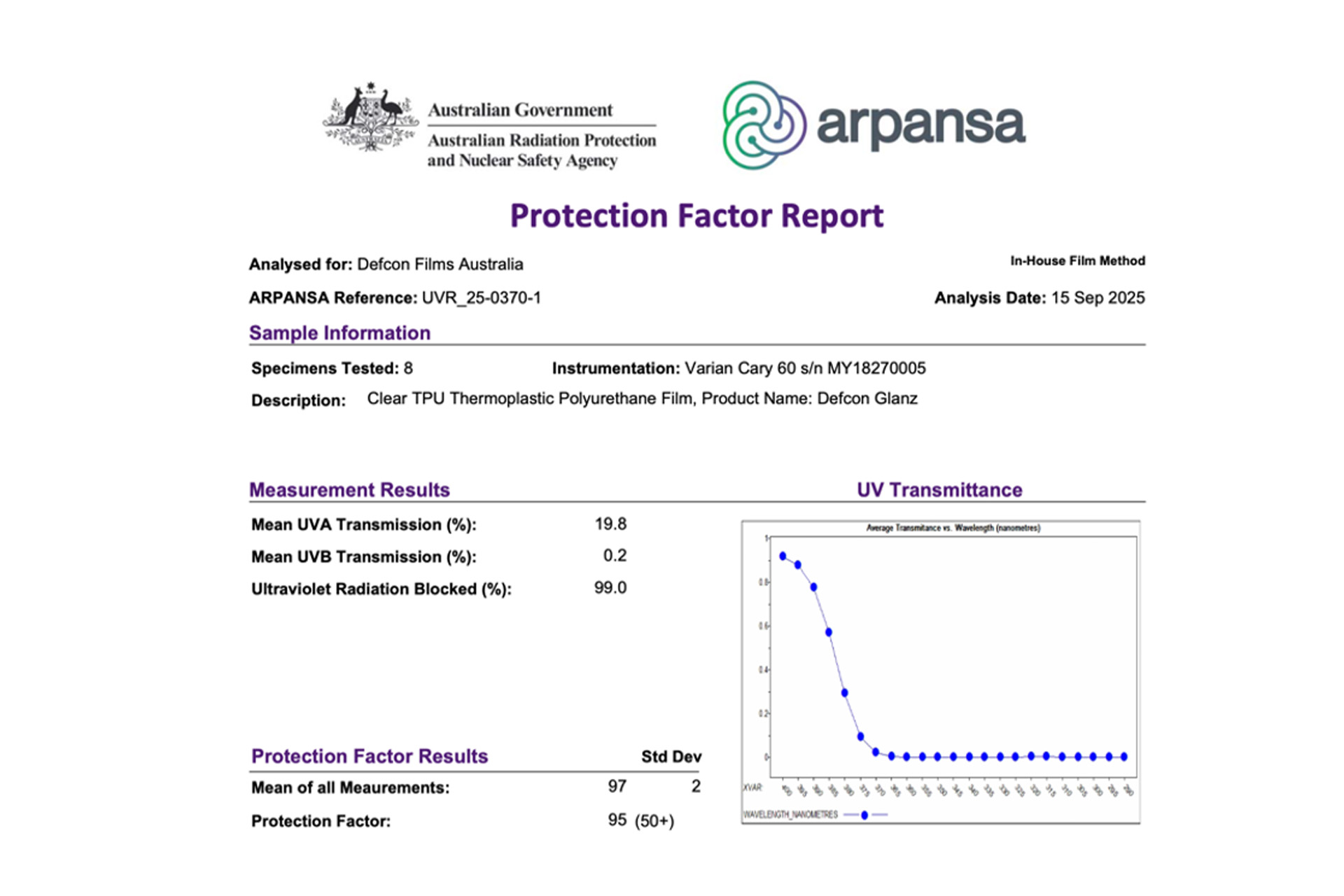
Defcon film is lab tested by ARPANSA in Melbourne, the Australian Radiation Protection and Nuclear Safety Agency, for UV protection performance. That matters for a simple reason: the testing happens at the agency that measures Australian radiation, in the market the film is sold into rather than a milder overseas baseline.
For installers, that is a concrete selling point in the quote conversation. When a customer asks why films are not all the same price, UV performance backed by local testing is the difference you can point to, and it is the difference the warranty is priced on.
What it means when you buy
UV stability is why the warranty periods can be what they are: 12 years on Defcon ONE at launch, 10 years on Glanz and Frozen, with every roll serialised and registered through e-Warranty at installation. The numbers are a bet on the chemistry, and the testing is what makes the bet rational.
If you want the full technical picture, thickness, top coat and adhesive specifications are laid out in PPF film specifications explained. To judge the film on your own table rather than on paper, order a free sample and run it through your own process.
Related reading: Australian Window Tint Laws by State: VLT Limits Before You Cut CoolVue