

Window Tint Heat Rejection: Reading TSER and IR on a Spec Sheet
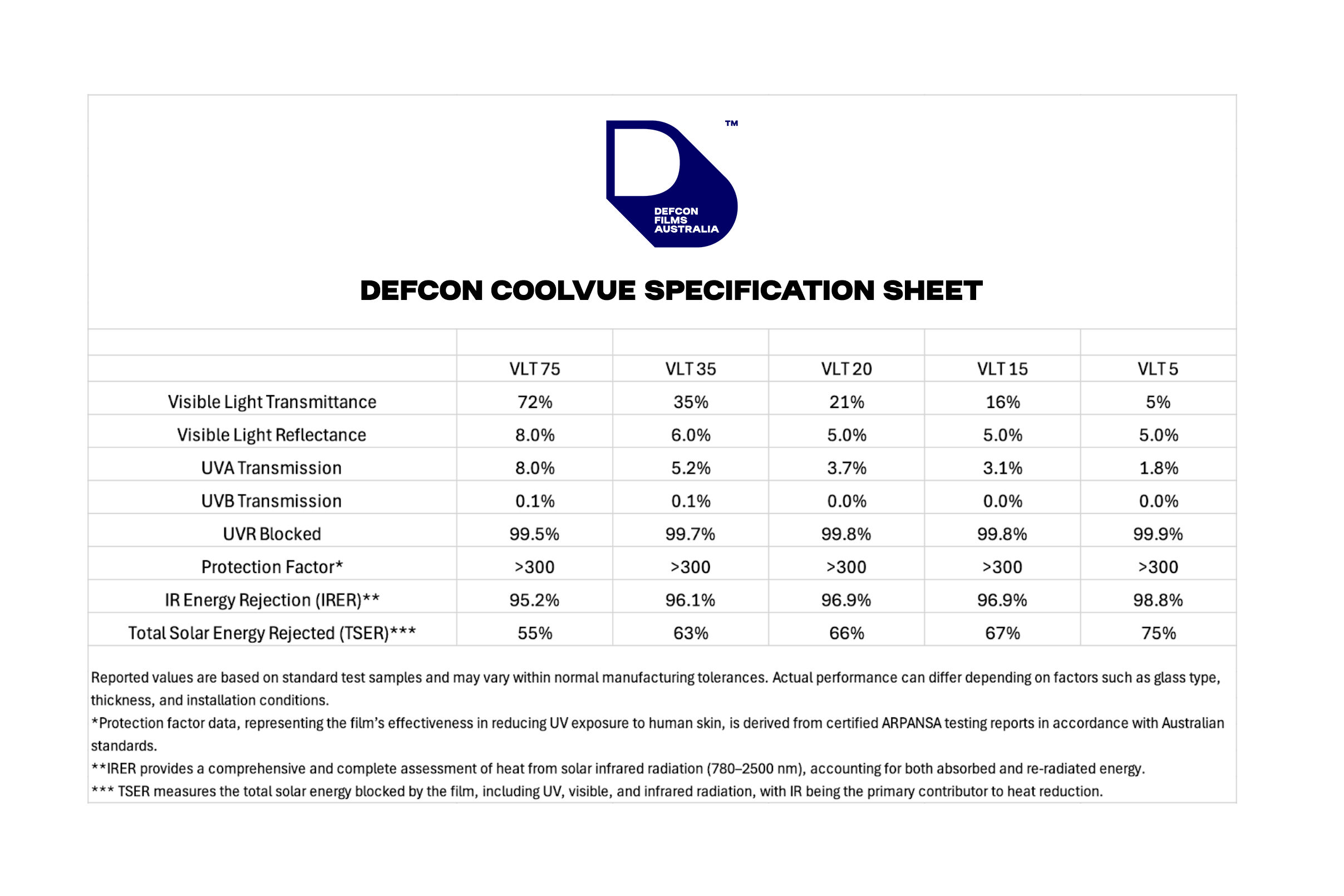
Window tint heat rejection is measured by TSER (total solar energy rejected), not by the IR rejection figure that most advertising leads with. The Window Film Association of Australia and New Zealand puts infrared at roughly 53% of the sun’s total energy in Australia, so a film that rejects 95% of infrared does not keep out 95% of the heat. The Defcon CoolVue specification sheet shows the gap clearly: IR energy rejection sits between 95.2% and 98.8% across the five grades, while TSER runs from 55% to 75%.
Customers now arrive with an IR percentage from an online ad and ask why your film looks weaker on paper. The answer is in how each line is measured.
What each line on a window film spec sheet measures
A tint spec sheet usually carries four groups of numbers, and only one of them answers the heat question on its own. Below are the measured film values from the Defcon CoolVue specification sheet.
| Grade | Visible light transmittance | Visible light reflectance | UV blocked | IR energy rejection | TSER |
|---|---|---|---|---|---|
| VLT 75 | 72% | 8.0% | 99.5% | 95.2% | 55% |
| VLT 35 | 35% | 6.0% | 99.7% | 96.1% | 63% |
| VLT 20 | 21% | 5.0% | 99.8% | 96.9% | 66% |
| VLT 15 | 16% | 5.0% | 99.8% | 96.9% | 67% |
| VLT 5 | 5% | 5.0% | 99.9% | 98.8% | 75% |
Visible light transmittance (VLT) is the share of visible light that passes through the film. It decides legality and how dark the glass looks, and the grade name is rounded: the VLT 75 grade measures 72% as a film. Visible light reflectance matters because every state caps reflectance at 10%, and CoolVue reads between 5% and 8%.
The IR line on the CoolVue sheet is labelled IR energy rejection (IRER). Its footnote states that it covers solar infrared between 780 and 2500 nanometres and counts both absorbed and re-radiated energy. That detail matters, because WFAANZ notes that different companies calculate IR values in different ways, so two IR figures from two suppliers may not describe the same band of light.
TSER is the composite figure. The CoolVue footnote describes it as the total solar energy blocked by the film, with UV and visible light counted alongside infrared. WFAANZ defines it as the amount of heat prevented from passing through the glass and tells buyers to look at TSER rather than IR rejection.
Why a 95% IR film can still let in about half the heat
Infrared is only part of the energy arriving at the glass. Visible light carries most of the rest, and once it passes through the window it is absorbed by the dashboard and seats, where it turns into heat. A film can stop nearly all of the infrared and still pass a large share of visible light, which is exactly what a light, legal front door film is designed to do.
The CoolVue figures show this in practice. The VLT 75 grade rejects 95.2% of infrared energy but transmits 72% of visible light, and its TSER is 55%. The VLT 5 grade rejects 98.8% of infrared and only 5% of visible light gets through, so its TSER rises to 75%. Infrared rejection moves by 3.6 points across the range while TSER moves by 20 points, and most of that difference comes from the visible light the darker grades hold back.
This is the reasoning behind the WFAANZ example that a film promoted as having 95% IR rejection does not block 95% of the heat. A tint shop that quotes the IR number as the heat number sets up a customer expectation the cabin will not meet on the first hot day.
How to compare two films fairly
WFAANZ gives a simple rule: compare the TSER of films that have the same visible light transmission. A 5% film will always post a higher TSER than a 35% film from the same range, so comparing a dark film from one supplier with a light film from another tells you nothing about which product performs better.
Before switching or adding a tint line, ask each supplier for four things per grade: measured VLT, visible reflectance, TSER and the wavelength band used for the IR figure. If a supplier gives an IR number but no TSER, or cannot say how the IR figure was measured, treat the IR figure as marketing rather than a specification.
Remember that spec sheet values are measured on standard test samples. The CoolVue sheet states that real performance changes with the glass and the installation, and the same is true of any film. Factory glass already removes some light, which is why the legal VLT test is always a reading of glass and film together. Our state by state window tint law guide covers the 35% front and 20% rear limits and the multiplication installers use to predict the installed reading.
The legal limit also caps how much heat rejection a front door can get from darkness alone. On front side glass, where 35% VLT is the minimum in every state, the light VLT 75 grade is the one that reliably passes once glass is factored in. Its 55% TSER as a film is the honest heat figure to quote for those windows, and a window tint gauge reading before and after the job shows the customer where their glass sits.
Explaining heat rejection at the counter
Most customers ask about heat, but ultraviolet is often the bigger health question. Cancer Council Australia notes that the tempered glass used in side and rear windows blocks UVB but can let through up to 79% of UVA, and that clear or tinted films can cut total UV through tempered glass by more than 99%. Every CoolVue grade blocks between 99.5% and 99.9% of UV, with a protection factor above 300 derived from ARPANSA testing, so a customer who wants UV protection does not need a dark film to get it. Our earlier post explains what ARPANSA testing means for film sold in Australia.
A short script works well. IR rejection tells you how much of the infrared band a film stops. TSER tells you how much of the total solar energy it stops, and that is closer to what you feel in the cabin. Darker grades raise TSER but can only go on the glass the law allows. Then show the customer the TSER for the grade that is legal on each window.
Forum buyers are often told to test samples under a heat lamp before choosing. Do the same in the workshop: apply a free sample roll to a door glass, check it for haze at low sun angles and take a VLT reading through the finished window. Write the target VLT and the film’s TSER for each window on the quote, then register the roll and vehicle through e-Warranty so the job record matches what was promised.
For shops building a tint menu, the window film for tint shops page explains how CoolVue fits alongside an existing range, the CoolVue product page lists the grades and the 1.52 m by 30 m roll, and volume buyers can go through the window film supplier program.
Frequently asked questions
Is a higher IR rejection figure always a cooler film?
No. IR rejection covers only the infrared part of sunlight, which WFAANZ puts at about 53% of solar energy in Australia, and suppliers measure it in different ways. TSER counts all of the solar energy, visible light included, so it is the better guide to cabin heat when two films have the same VLT.
Does darker tint reject more heat?
Usually, because a darker film blocks more visible light, and visible light becomes heat once it is absorbed inside the car. On the CoolVue range, TSER rises from 55% on the VLT 75 grade to 75% on the VLT 5 grade, while IR energy rejection changes by less than 4 points. Darker grades can only be used where state VLT limits allow.
What TSER can a legal front window film reach?
On front side windows the combined glass and film reading must stay at or above 35% VLT in every Australian state and territory, which in practice means a light grade. The CoolVue VLT 75 grade measures 55% TSER as a film, with 99.5% of UV blocked, and the installed figure will vary with the glass it goes on.