

Australian Window Tint Laws by State: VLT Limits Before You Cut CoolVue
Australian window tint laws follow one pattern: front door glass must keep a visible light transmittance (VLT) of at least 35%, glass behind the driver may go to 20% in every state and territory except the Northern Territory, which allows 15%, and no film on any window may reflect more than 10% of light. The windscreen takes no film at all apart from a band across the top. The catch for a tint shop is that every one of those numbers is a reading of glass plus film together, not the number printed on the roll. Below is the state table with the government sources, followed by how each Defcon CoolVue grade reads once it is on the car.
The state by state VLT table
Each row comes from the transport authority named in the source column. Read the source before quoting a job in a state you do not normally work in, because the exemptions differ more than the headline numbers do.
| State | Front side windows | Behind the driver | Reflectance | Source |
|---|---|---|---|---|
| Victoria | 35% minimum | 20% minimum with a mirror each side | 10% maximum | Transport Victoria VSI 2 |
| New South Wales | 35% minimum | 20% with two mirrors, 35% with a driver side mirror only | 10% maximum | Transport for NSW fact sheet, May 2025 |
| Queensland | 35% minimum | 20% minimum with a mirror each side | 10% maximum | WFAANZ national summary |
| South Australia | 35% minimum | 20% minimum | 10% maximum | SA.GOV.AU MR430 |
| Western Australia | 35% minimum forward of the B pillar | 20% minimum behind the B pillar with ADR 14 mirrors | 10% maximum | Transport WA IB-119D |
| Northern Territory | 35% minimum | 15% minimum | Must be non-reflective | NT.GOV.AU vehicle accessories |
Tasmania and the ACT sit on the same 35% front and 20% rear figures according to the Window Film Association of Australia and New Zealand, which publishes links to every jurisdiction. The Victorian guideline is dated October 2021 and the NSW fact sheet May 2025.
Windscreens, goods vehicles and sunroofs: where the rules bend
Windscreens are the one surface with no room to move. Victoria, NSW, SA, WA and the NT all prohibit film on the windscreen except for a band at the top, sized as the area above the wiper arc or the top 10% of the screen, whichever is greater. Victoria and SA both add that the band must not cover any camera or sensor mounted inside the glass, which matters on anything with lane assist.
Goods vehicles are the opposite case. Victoria applies no minimum VLT behind the driver on vehicles built primarily for carrying goods, provided a mirror is fitted on each side. SA states the same rule as 0% for panel vans and single cab utes. NSW lists no minimum VLT for windows rearward of the driver on commercial vehicles. A dual cab that has been converted to a passenger layout loses that allowance in SA, so ask what the compliance plate says before you quote a blackout.
Roof glass is the third special case and the one most tint shops now meet weekly on EVs. Transport WA lists sunroofs and glazing in the roof among the exemptions from VLT limits. That is the surface where a clear protection film such as Defcon Crystal Shield belongs rather than a dark tint, because the job is UV and stone protection over a panoramic panel, not privacy.
Why the number on the roll is not the legal number
WFAANZ puts it plainly: the combination of glass plus film cannot exceed the VLT limit. Every state document says the same thing in its own words, and NSW, Victoria and SA each add that privacy glass already darker than the limit may take no film at all. Victoria spells out that the prohibition includes clear film. SA requires the front glass itself to transmit at least 70% before any film goes on, which tells you how much light the glass alone already removes.
The working estimate installers use is to multiply the two readings. Glass that reads 80% with a film rated at 35% lands around 28%, which fails a front door in every state. The same glass with a film rated at 72% lands around 58%, which passes. Because the legal test is a reading taken on the installed window, a calibrated VLT gauge on the bare glass before you cut is the only way to know which grade will pass, and SA’s own guideline recommends the installer take that test.
Matching CoolVue grades to each window
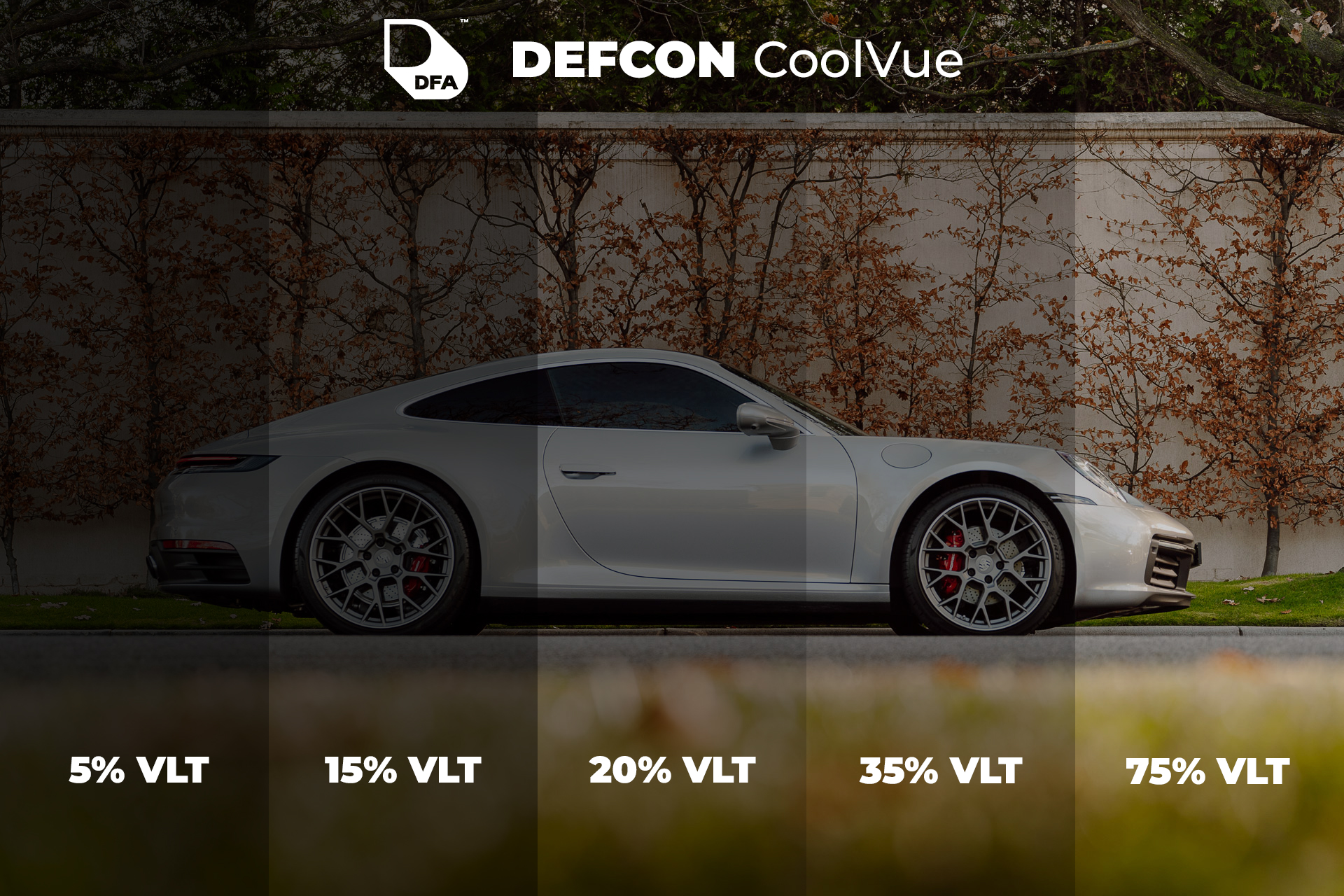
The CoolVue product page lists five grades, VLT 75, 35, 20, 15 and 5, supplied as 1.52 m by 30 m rolls. The specification sheet on the CoolVue page gives the measured film figures: VLT 75 transmits 72% of visible light, VLT 35 transmits 35%, VLT 20 transmits 21%, VLT 15 transmits 16% and VLT 5 transmits 5%. Visible light reflectance sits between 5% and 8% across the range, under the 10% ceiling every state applies.
Put those film readings against the table and the choices sort themselves out. On front doors, VLT 75 is the grade that stays above 35% once glass is factored in. Behind the driver in a 20% state, VLT 35 is the safe choice on most factory glass, and VLT 20 only passes where the glass reads very high, so measure before you promise. VLT 15 and VLT 5 are goods vehicle and non-road grades in every state except the NT, where the 15% limit puts VLT 20 within reach behind the driver.
The heat and UV performance does not depend on going dark. The same specification sheet lists UV rejection from 99.5% on VLT 75 up to 99.9% on VLT 5, infrared energy rejection from 95.2% to 98.8%, and total solar energy rejected from 55% to 75%. The protection factor of more than 300 on every grade is derived from ARPANSA testing, the same Melbourne laboratory that tests Defcon PPF, covered in our earlier post on ARPANSA UV testing. The nano-ceramic construction is non-metallic, so it does not interfere with GPS, toll tags or phone signal, and the low-angle haze control keeps the glass optically clear at dawn and dusk. The light grade blocks almost the same UV and heat as the dark one, which is the line to give a customer who wants a legal front door.
Putting the rules into the quote
Write the target VLT for each window into the quote, not just the film grade. A quote that states the legal figure per window and names the CoolVue grade chosen to achieve it protects the shop when a roadworthy inspector puts a gauge on the glass a year later. Record the bare glass reading and the installed reading on the job card, then register the roll and the vehicle through e-Warranty within 7 days of invoice, so the film and the vehicle sit on one installer record if a question ever comes up.
For a shop that has not run CoolVue before, the practical test is a door glass in your own bay: check haze at low sun angles, then take a VLT reading through the finished window and compare it with the state limit. A free sample roll is available to professional workshops for exactly that, and the window film for tint shops page covers how CoolVue fits alongside an existing tint menu. Trade pricing sits behind the login on the window film supplier page and is never shown to your customers.
Is 20% tint legal on the front windows anywhere in Australia?
No. Every state and territory sets 35% VLT as the minimum for the driver and front passenger windows, measured through glass and film together. The 20% figure, or 15% in the NT, applies only to windows behind the driver, and in NSW it also requires a mirror on each side of the vehicle.
Can I put clear film on privacy glass?
Only if the finished reading stays within the state limit. Victoria, NSW and SA each state that factory privacy glass already darker than the limit may not take any film, and Victoria’s guideline says that includes clear film, because even a clear film reduces the combined transmittance below what the regulation allows.
Which CoolVue grade is legal on rear windows?
In a 20% state, CoolVue VLT 35 on factory glass usually reads above 20% and is the standard choice. VLT 20 measures 21% as a film, so the combined reading with glass typically falls below 20% unless the glass is unusually clear; in the NT the 15% limit makes VLT 20 workable. Measure the bare glass with a calibrated gauge before cutting, because the inspector will measure the installed window, not the roll.